
Pump Ops
Hand Methods
Fast fireground friction loss estimates — no calculator, no chart, just math you can do in your head
On the fireground you don't have time to pull a friction loss chart or run an app. Hand methods trade a small amount of precision for speed — they get a driver/engineer to a workable pump discharge pressure in seconds, using nothing but the GPM being flowed. Every method below is an estimate, not gospel — always calibrate against your department's actual friction loss tables and pump charts during training.
✋ Quick Friction Loss for 1¾″ Attack Lines
Take the flow you're discharging, divide by 50, then multiply by 12. That gives you the friction loss for every 100 feet of 1¾″ line. This shortcut is built around the fact that friction loss roughly scales with the square of the flow rate — the "divide by 50" step is doing that scaling for you without requiring you to actually square anything by hand.
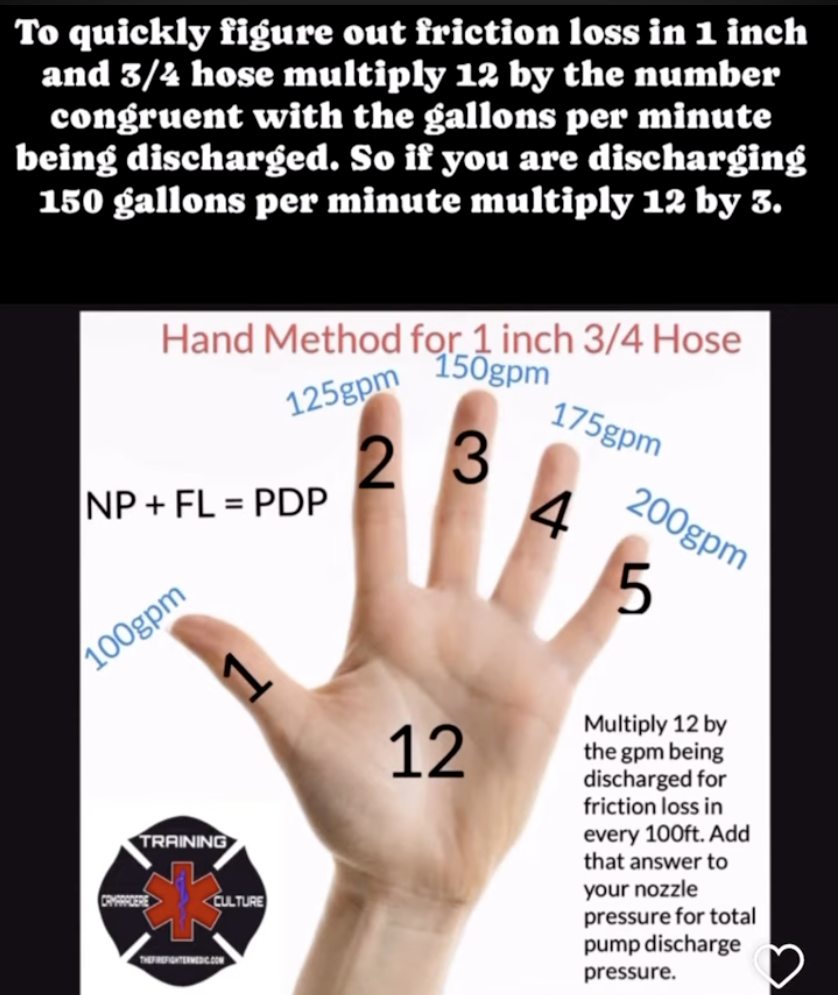
Each finger = a common 1¾″ flow rate (100–200 GPM). Multiply 12 by the finger number to get friction loss per 100 ft of hose — add nozzle pressure (NP) to get pump discharge pressure (PDP).
This is the rated discharge of the nozzle on the line — usually printed on the nozzle or fixed by your department's SOG (commonly 150 or 185 GPM on a 1¾″ smoothbore or fog tip).
This converts your actual flow into a simple multiplier relative to a 50 GPM baseline — that's the "which finger am I on" step.
12 psi is the friction loss constant for 1¾″ hose per 100 ft at the 50 GPM baseline flow.
The result above is per 100 feet. A 200-ft preconnect doubles it; 300 ft triples it.
PDP = Friction Loss (all sections) + Nozzle Pressure + any appliance or elevation adjustment.
📊 Quick-Reference Table — 1¾″ Hose
| GPM | FL / 100 ft | FL / 200 ft |
|---|---|---|
| 100 | 24 psi | 48 psi |
| 150 | 36 psi | 72 psi |
| 185 | 44.4 psi | 88.8 psi |
| 200 | 48 psi | 96 psi |
| 250 | 60 psi | 120 psi |
✋ Quick Friction Loss for 2½″ Supply/Attack Lines
This one only works cleanly for flows of roughly 150 GPM or more through 2½″ hose. Take the gallons-per-minute number, look at just its first two digits, and subtract 10. What's left is your friction loss in psi for every 100 feet of 2½″ line.
Same finger-counting idea, different hose. Each position = a common 2½″ flow rate in 50 GPM steps starting at 150. Drop the first two digits of the GPM, subtract 10, and that's the psi.
Drop 10 is calibrated for higher flows typical of 2½″ handlines and supply evolutions. It gets inaccurate at low flows — use the 1¾″ method's underlying math (or your department's chart) for smaller lines.
250 GPM → "25". 300 GPM → "30". 175 GPM → "17".
That's your friction loss in psi for every 100 feet of 2½″ hose at that flow.
Same as any other FL calculation — multiply by number of 100-ft sections, then add nozzle pressure (and appliance/elevation) to get PDP.
📊 Quick-Reference Table — 2½″ Hose
| GPM | First 2 Digits | FL / 100 ft |
|---|---|---|
| 150 | 15 | 5 psi |
| 200 | 20 | 10 psi |
| 250 | 25 | 15 psi |
| 300 | 30 | 20 psi |
| 350 | 35 | 25 psi |
Below roughly 150 GPM, "first two digits minus 10" starts producing friction loss numbers that are too low to be realistic (and can even go negative). Don't use Drop 10 for light flows through 2½″ line — fall back to your department's friction loss chart or coefficient-based formula (FL = C × Q² × L/100) instead.
✋ Quick Friction Loss for LDH (3″, 4″, 5″ Supply Line)
Large diameter supply hose has such low friction loss per 100 ft that hand methods here use a percentage-of-flow shortcut instead of a fixed multiplier. The core idea: take a percentage of your GPM (not the raw flow) as your friction loss in psi per 100 ft, and use a bigger percentage for smaller-diameter LDH.
Only three positions are "live" here — index, middle, and ring hold the percentage figure for 5″, 4″, and 3″ LDH. Thumb and pinky are grayed out because there's no common 2″ or 6″ supply size to assign them in most departments.
Most departments run 4″ or 5″ supply line; some still run 3″. The percentage used scales with how much smaller than 5″ the hose is — 5″ has the least friction loss of the three, so it uses the smallest percentage.
Common taught values: 5″ ≈ 2% of GPM per 100 ft, 4″ ≈ 5% of GPM per 100 ft, 3″ ≈ 10% of GPM per 100 ft. These percentages vary by manufacturer, hose age/condition, and department SOG — treat the values here as a commonly-taught starting point, not a universal constant.
Example: 5″ hose flowing 1000 GPM at 2% → 1000 × 0.02 = 20 psi FL per 100 ft.
LDH supply lays are frequently 300–600+ ft — don't forget to multiply by the actual number of 100-ft sections in the lay.
📊 Typical Percentage Figures by LDH Size
Verify these percentages against your own department's pump charts before relying on them operationally — LDH friction loss coefficients differ between manufacturers and change as hose ages.
| Hose Size | Method | Typical Use |
|---|---|---|
| 1¾″ | ×12 Method | Preconnect handlines, interior attack |
| 2½″ | Drop 10 | Big line handlines, standpipe, blitz attack |
| 3″/4″/5″ | Percentage Method | Supply lines, relay pumping, master streams |
© The Firefighter Medic — All rights reserved. Unauthorized reproduction prohibited.
These are fireground ESTIMATION shortcuts, not a substitute for exact hydraulic calculations. Coefficients and constants vary by department, hose manufacturer, and hose condition — always verify against your own SOG and pump charts.
See also: Math Class → Pump Operations calculators for exact coefficient-based friction loss, nozzle reaction, and relay pumping math.